This material may not be published, broadcast, rewritten, or redistributed. ©2026 Twincitieslocalnews - local news, local sports

Thursday, November 19, 2026
By MN Newswire staff
Published: September 25, 2026 4:04pm
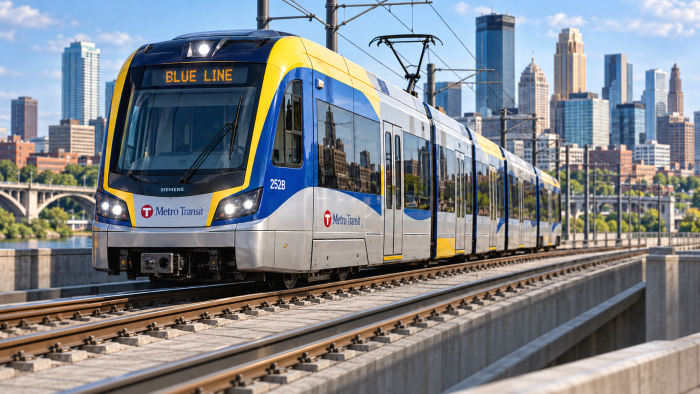
MINNEAPOLIS - A dispute over who should cover a $224 million funding gap continues to hold up the Blue Line light rail extension, leaving a major transit project for Minneapolis and its northwestern suburbs without a complete financing plan.
Hennepin County commissioners and Metropolitan Council officials remain divided over how to close the shortfall. County leaders maintain that the council has resources available to help, while council officials say those dollars are already committed to other needs.
The disagreement has consequences beyond the immediate budget debate. Hennepin County says all local funding must be committed before the project can apply for $752 million in federal support, making resolution of the shortfall a necessary step toward construction.
The proposed extension would travel roughly 13 miles from downtown Minneapolis through North Minneapolis, Robbinsdale and Crystal to Brooklyn Park. For communities along that corridor, the unresolved funding question prolongs uncertainty over when — and whether — the promised rail connection will become a reality.
Hennepin County Board Chair Irene Fernando expressed frustration with what she described as unequal treatment of the corridor compared with other parts of the metropolitan area.
“The very direct frustration I have is that this corridor is always treated differently, and worse, than the rest of the region,” Fernando said. “Every single time.”
Fernando also criticized what she characterized as shifting expectations and requirements, warning that a prolonged dispute could deepen community mistrust.
Her comments reflect a broader disagreement over regional transportation priorities: how to pay for a major expansion while meeting existing transit obligations, and how long communities awaiting new service should have to wait.
Hennepin County has already increased its financial commitment. On Aug. 4, commissioners voted to raise the county’s contribution to $2.254 billion. The county’s September project update nevertheless continued to identify a $224 million funding gap.
At a public discussion earlier this month, county officials said they had reached the limit of what the county could contribute, according to MPR News. They pointed to transit resources administered by the Met Council as possible ways to cover some remaining costs.
One area of disagreement involves the purchase of light rail vehicles. County officials have raised the possibility of paying for some vehicles through the council’s broader transit system budget. Council officials have disputed the county’s interpretation, saying those purchases must be evaluated within federal requirements, state law and existing agreements, MPR reported.
That leaves the agencies at odds over both the availability of money and which responsibilities it can cover. Identifying funds within a regional transit budget does not, by itself, establish agreement that those funds can be redirected to the extension.
The funding dispute follows a substantial increase in the project’s estimated cost.
In June, the Metropolitan Council announced a $3.58 billion project budget following a federal risk assessment, an increase of $336 million over the earlier estimate. The council attributed the increase in part to design changes requested by communities, including an additional station at Washington and West Broadway avenues and revisions to the Lowry Avenue station. The budget also includes a contingency to account for uncertainty.
Meanwhile, questions about the project’s effect on existing neighborhoods remain unresolved for some residents.
Community pushback has included concerns that people could be displaced to make room for tracks and related infrastructure. Those concerns add another dimension to a debate often dominated by budgets and construction schedules: what the project would mean for people already living along its route.
At the September public discussion, speakers also raised concerns about how future development could affect current residents. MPR reported that Ricardo Perez of the Blue Line Coalition called for anti-displacement efforts to remain part of the planning process as investment reaches the corridor.
Hennepin County says anti-displacement strategies are part of its approach before, during and after construction. The county also argues that the extension would serve a substantial population dependent on public transportation. Its projections anticipate about 10,000 daily riders, roughly half from households without access to a car. Those figures are forecasts, rather than existing ridership.
The potential benefits have not eliminated disagreement over whether rail construction should remain the immediate priority.
MPR reported that some participants in the September discussion urged officials to reconsider the project’s costs and schedule, with one transit rider advocating for additional bus service in the northern corridor while the rail proposal is reassessed. Supporters emphasized the importance of a lasting connection to jobs, education and health care.
The construction timetable remains conditional.
In its June 18 update, the Met Council said early construction could begin in late 2027 if it submitted a federal Full Funding Grant Agreement application within the following six months and received timely federal approval. Under that scenario, major construction would begin in 2028 and finish by 2032, followed by testing and passenger service in 2033. The six-month application window described in that announcement began in June.
Those dates describe a possible path forward, rather than a guaranteed opening schedule. The council has said the nonfederal funding must be identified and committed before the application is submitted.
For now, the central question remains who will provide the remaining money. Until Hennepin County and the Metropolitan Council resolve that disagreement, residents along the proposed route face continued uncertainty over a project intended to reshape transportation across the northwest metro.