This material may not be published, broadcast, rewritten, or redistributed. ©2026 Twincitieslocalnews - local news, local sports

Thursday, November 19, 2026
By MN Newswire staff
Published: October 23, 2026 8:20am
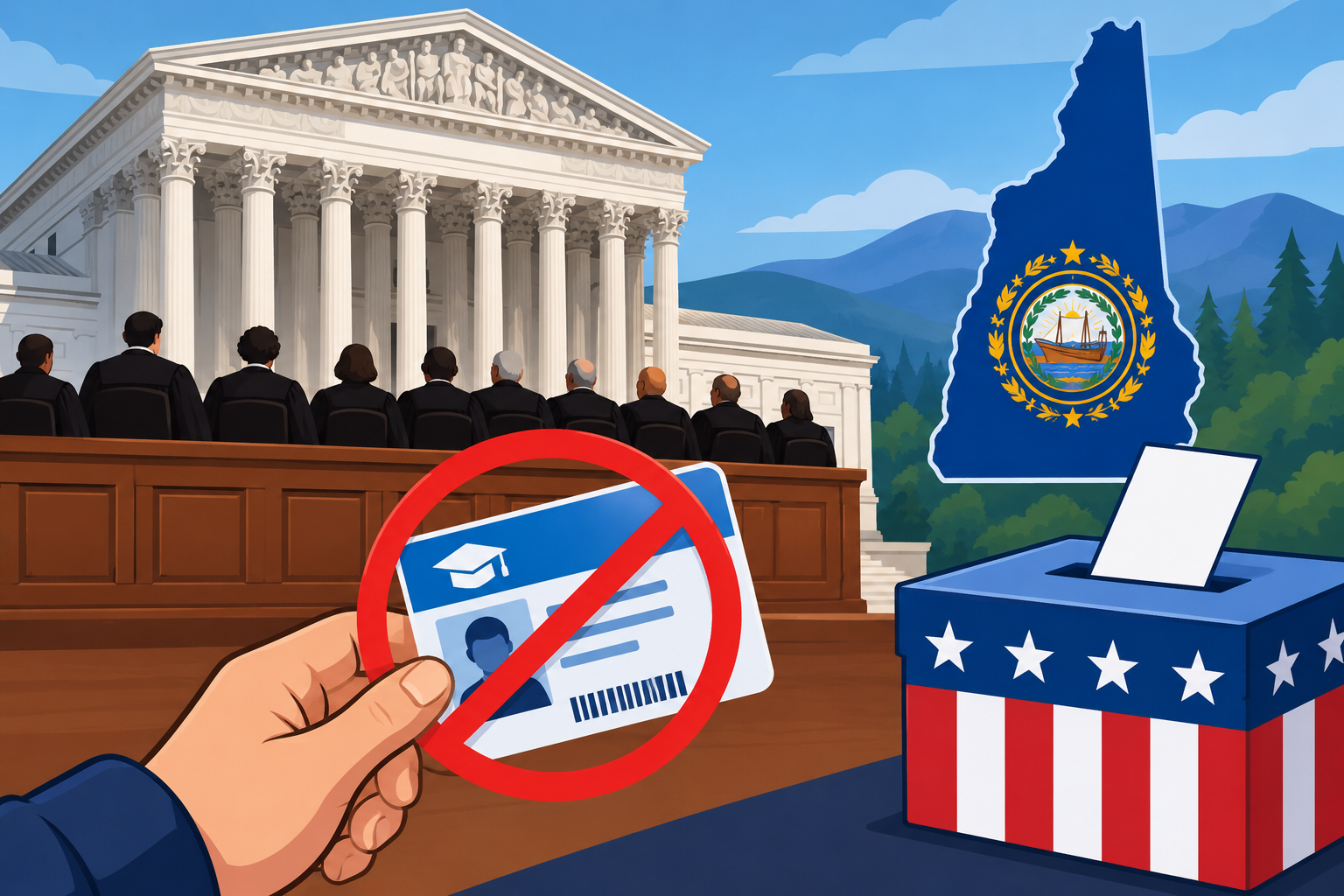
The U.S. Supreme Court has cleared the way for New Hampshire to reject student identification cards as a valid form of voter identification for the November midterm election, temporarily allowing a state law to take effect while a legal challenge continues.
The court issued a stay Thursday, blocking a lower court injunction that had prevented the state from enforcing the restriction. The decision means election officials can refuse to accept student IDs under a law passed by the New Hampshire Legislature earlier this year.
House Bill 323, approved in April, removed student identification cards from the list of acceptable identification for voters. The change has become the subject of a lawsuit brought by the Coalition for Open Democracy, which is challenging the law and seeking to prevent its enforcement.
New Hampshire Attorney General John Formella said state officials had already taken steps to implement the new requirements before the legal dispute interrupted those efforts.
According to Formella, Secretary of State David Scanlan issued guidance to election officials explaining the change after the law took effect. The state also conducted multiple training sessions to prepare election workers for the updated identification rules.
Legal dispute centers on election timing
The lawsuit resulted in an early October decision by the U.S. District Court for the District of New Hampshire that blocked the state from implementing the change. The state Department of Justice subsequently asked the Supreme Court to intervene, arguing that leaving the injunction in place could create confusion for voters and election officials shortly before Election Day.
The dispute involves the legal principle established in Purcell v. Gonzales, a 2006 Supreme Court case that cautioned courts against making changes to election procedures close to an election. Such changes can create uncertainty for voters, disrupt election administration and potentially prevent eligible voters from casting ballots.
State officials argued that allowing the lower court's injunction to remain in effect would interfere with the implementation of the law and complicate preparations for the November election.
Formella welcomed the Supreme Court's decision, saying New Hampshire has a responsibility to enforce its election laws.
"The Supreme Court’s decision is an important victory for our efforts to defend those laws and prevent last-minute court orders from creating uncertainty for voters and election officials," Formella said in a statement.
He added that his office would continue defending the state's election requirements in the ongoing court proceedings.
Justice Jackson dissents
Supreme Court Justice Ketanji Brown Jackson disagreed with the decision to grant the stay, arguing that the lower court's actions did not violate the principles established by the Purcell case.
Jackson said the lower court had not rewritten New Hampshire's election law. Instead, she argued, it had required the secretary of state to correct misleading statements so that the information provided to voters accurately reflected the written law.
She also disputed the state's argument that the injunction would cause confusion during the election process.
In her view, ensuring that election officials provide accurate information about voting requirements would reduce uncertainty for both voters and poll workers.
Jackson further argued that higher courts should be cautious about intervening when a lower court has ordered government officials to stop distributing inaccurate information about voting rules immediately before an election.
Her dissent highlighted the disagreement over how the Purcell principle should apply when a court order concerns the accuracy of official election guidance rather than a change to the underlying statute.
Voting rights group criticizes ruling
The Coalition for Open Democracy criticized the Supreme Court's order, saying it reverses protections that had been in place for nearly three weeks and could create additional uncertainty ahead of the election.
In a statement, counsel for the organization called the decision "wrong" and argued that it would allow an unconstitutional policy to remain in effect while the case proceeds.
The group said both the federal district court and the U.S. Court of Appeals for the First Circuit had previously declined to grant the state the relief it sought.
The organization also praised Jackson's dissent, saying her position reflected its view that the Purcell principle should not be used to block court orders requiring accurate information about voting procedures.
The coalition said it would continue litigating the case to protect young voters' voting rights in New Hampshire.
What the ruling means for voters
The Supreme Court's order allows New Hampshire election officials to reject student IDs as acceptable voter identification for the November election while the lawsuit continues.
The stay is temporary and does not resolve the underlying legal challenge to House Bill 323. The courts will still need to determine whether the law itself can stand.
For voters who previously relied on student identification cards, the ruling means they may need to use another form of identification accepted under New Hampshire law.
The state Department of Justice has said it will continue defending the law in future proceedings.
The case leaves election officials preparing for November's election under the restored identification restrictions while the legal dispute over the state's policy remains unresolved.